-The Why?-
Around six months ago, in early February, I was planning a trip (mostly) throughout the Mediterranean; I had figured out a route that spanned around fifteen countries, and was almost entirely sure I could make enough money before I left to make it reality. I would begin in the west of France and diverge from the route every other week in order to hike trails that were open year round – backpacking the rest of the way, finally ending in Montenegro three months later.
Then my father made the mistake of Mentioning something.
The key problem with this is that my father and I are far more alike than any of my younger selves could have ever imagined, so when he leans on the kitchen counter and says something along the lines of ,”that’s all well and good, but if you’re planning to diverge so much why not try a longer walk like say – the Camino ?”, I never stood a chance.
Now, to give him credit, he was merely bringing up – as an example – a trek he had heard of from just beyond the Pyrenees to Santiago de Compostela. What he did not think about was the fact that I am stubborn to the point of stupidity and have a habit of becoming extremely focused on certain ideas then deliberately making things harder for myself.
So from that afternoon on, I became obsessed. Every spare minute was spent reading about the history, the why. I was falling in love with lands I had never entered. The further my ‘research’ went, the longer my plans became. Gone were thoughts of Italy and Greece, replaced instead by the concept of walking for months at a time. Gradually, my route grew, creeping steadily past Saint-Jean-Pied de Port to Le Puy. I stumbled across a blog detailing one mans’ travels from Geneva to Finisterre. Two birds with one stone – both ends of my walk extended. A month turned to two, two to four.
Finally, I had my route down. I would follow the GR65 from Geneva, Switzerland across the entirety of France and Spain, ending at the ‘end of the world’ in Finisterre. Now all that was left was to figure out gear and – wait what do you mean there’s alternative variants to the routes ??
Out came the notes again as I poured over my new potentials. After a week of deliberation I would land on a 2200km hike that diverted away from the crowds, into the quiet I so desperately craved. It was a mismatch of Caminos, paper-mached together, and it was perfect. I was finally decided.
-The Route-
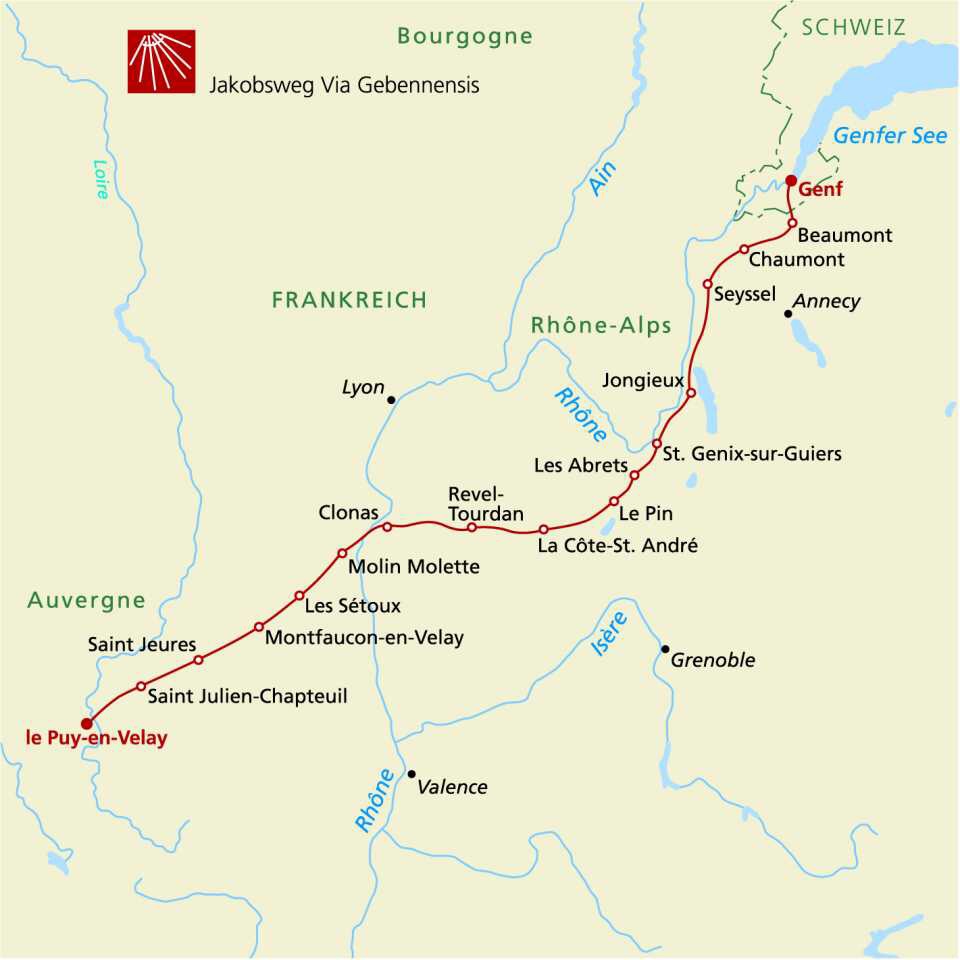
The start of my adventure remained in Geneva (Genf), Switzerland, at the 13th Century Basilica of Notre-Dame. Here is where I would retrieve my pilgrims credential, which would allow me access to cheaper food and accomodation along my journey. I would follow the Via Gebennensis for a little over 350km, crossing into and meandering through rural southern France until I reached the town of Le Puy-en-Velay.

From Le Puy I would transfer across to the Via Podiensis, which would send me progressively west over the course of 750km until I arrived in Saint-Jean-Pied-de-Port, in the shadow of the Pyrenees. In this stretch the volume of pilgrims would increase – the Via Gebennensis, whilst slowly becoming more popular, is still largely a ‘quiet’ Camino experience, whereas the Podiensis has had an uptick in hikers since Covid began declining. However, this increase would be nothing compared to what was to come.
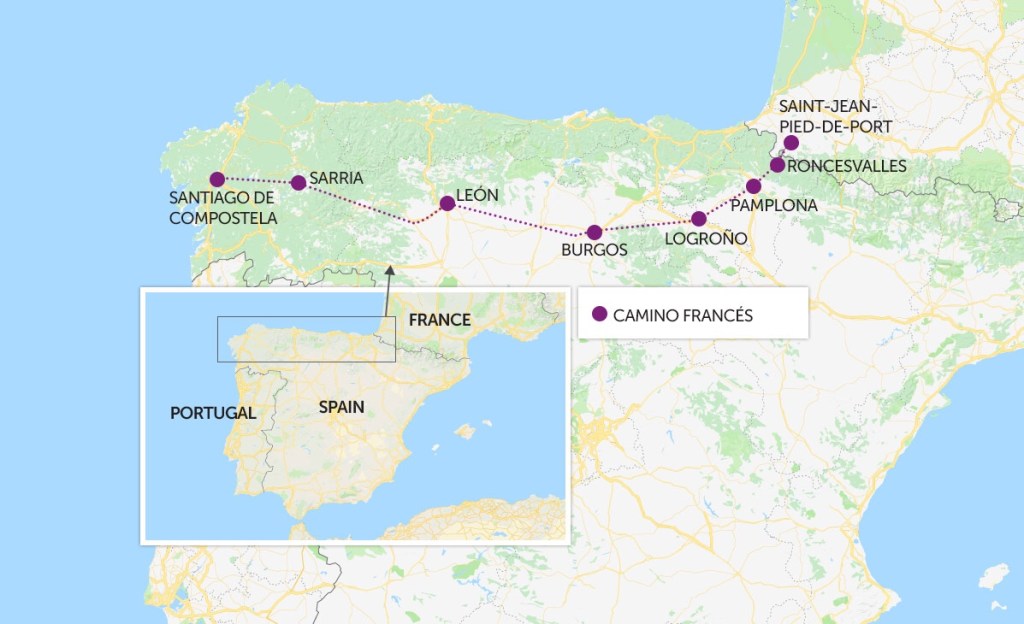
The Camino Frances – easily the most popular of all the ways to Santiago. 414,340 pilgrims completed the journey in 2022 alone, and the number continues to grow. Most attribute the appeal to the sheer number of other hikers with whom to create bonds with, becoming a “family”. It is widely considered the most social route, and has a wealth of larger towns and cities along the way. All things considered, it was the part I was most apprehensive about.
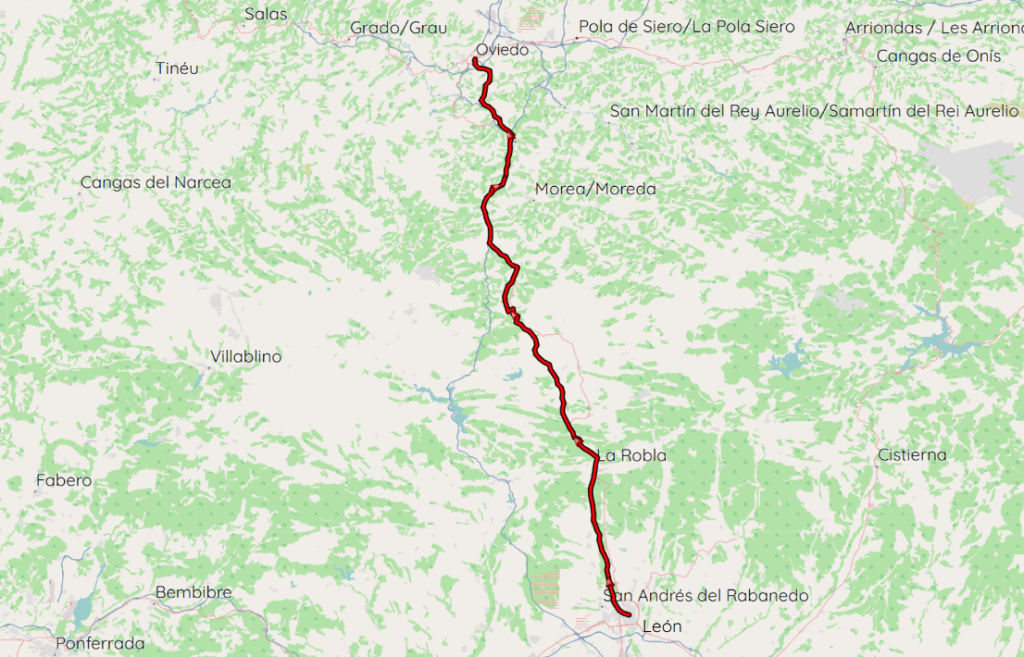
Good for me, I had options. I would not stick to the Frances, only crossing 475km of the total 800km, making my way from Saint-Jean at the edge of France to Leon at the northwestern corner of the Central Meseta. Here, I would change directions, heading north on the Camino de San Salvador for 120km until I reached Oviedo, the capital of the Asturias region.
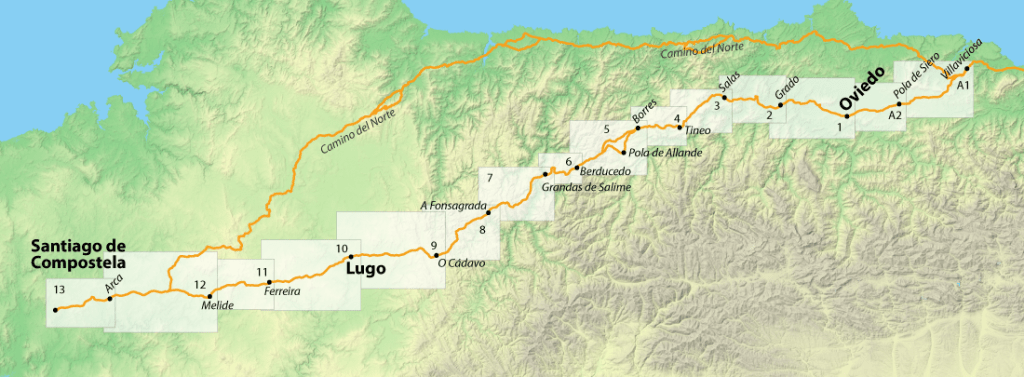
Once I reached Oviedo, I was in for a treat. I would be following the Camino Primitivo until I came to Melide, where the Frances and Primitivo merge a few days walk from Santiago de Compostela. Nicknamed the ‘original’ way, the Primitivo is a 320km hike up and down the Cantabrian Mountains and through the hills of Galicia, and one of the most isolated routes across Spain. Only roughly 8,000 people per year choose to walk it, and I. Could. Not. Wait. Quiet, seperate, windy and a little dangerous – far more interesting to me than the Frances.
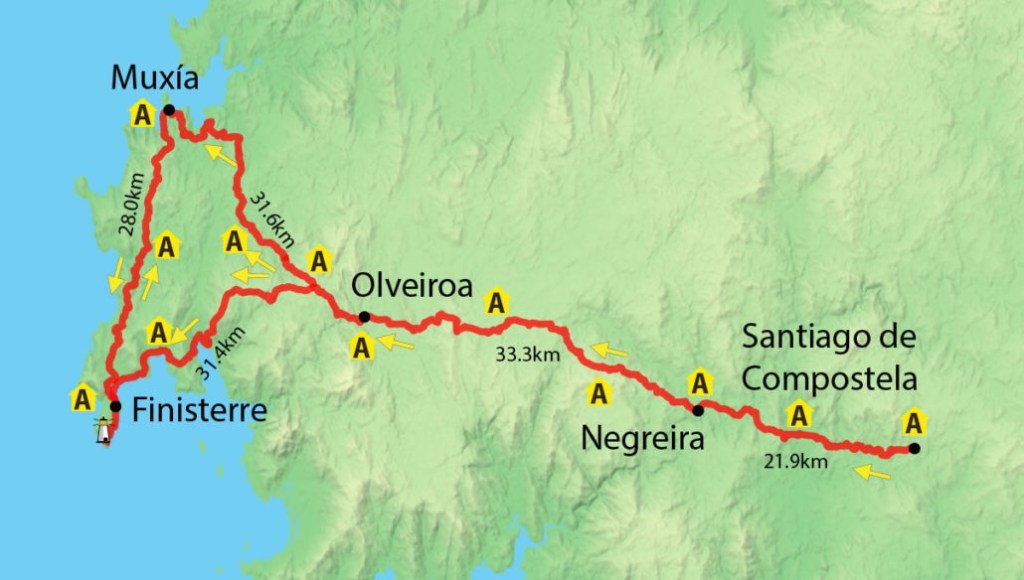
But this would not be the last of my adventure! Santiago was not my final goal – at least not the first time. I wanted to reach what was once called ‘the end of the world’; Finisterre. I would complete the loop while I was at it – from Santiago to Muxia, then Muxia to Finisterre. This would emotionally be the end of my Camino (although I haven’t made it yet so we’ll see), but not quite physically. From Finisterre I would walk back to Santiago, where I would then fly back to Germany.
-The Preparation-
I would be gone four months, alone in the urban wilderness with only one supermarket a day (gasp!). I’d be averaging around 20-30km a day, from now till Christmas – how would I manage ??? Well, only an absolute moron would undertake a trek of this magnitude with this much sustained effort without any form of training, without so much as doing a practice hike with the very bag he’d be walking with.
So ,,,,,,,,
Onto gear !
-The Gear-
Now, it wasn’t exactly fair to say I’d done z e r o preperation whatsoever ; I’d grown up camping and hiking – granted, never for four months at a time – but there’s a first time for everything! I had experience with First Aid, and I knew how to cook. I was not entirely helpless, just maybe a little blinded by excitement.
To add to the adventure (and save a bit of money), I’d long since made the decision to split my nights between standard accomodation and camping. For pilgrims, ‘normal’ accomodation refers to gîtes (French) or alberques (Spanish). These were essentially subsidised hostel rooms that averaged between €10 and €20 a night, made especially for pilgrims to stay in a maximum of one night. I would attempt to sleep in gîtes at least twice a week – enough to be able to wash my clothes every three days – the rest of the time I would camp.
My first port of call, then, was a tent. I had with me a small one that weighed a little over a kilo and was, in the name of blending in – wild camping was not technically legal – bright fucking red! It stayed strapped to my bag, along with my sleeping mat and towel. For food I had with me a simple pot cooker – sans lighter. And gas. Both of those I’d figure out later. I also brought a lightweight hammock for dry nights, as well as a raincoat for less dry ones. My sleeping bag was thin plastic and left a little to be desired, but it was autumn yet, and I had thermals and fleece for when winter arrived. Hopefully it would hold me over until December.
Now all that remained was to organise my travel and be on my way :]
 pocket-full-of-seaglass
Leave a comment